
Taking longer to read or complete written work
Child Development & Learning Centre Bengaluru
✦ • Kamanahalli, Bengaluru
ACADEMIC LEARNING SUPPORT
Helping Children Build Stronger Foundations in Reading, Writing and Numeracy
Every child learns differently.
Some children understand concepts quickly through traditional classroom instruction, while others may need more time, repetition, visual guidance or a personalised approach.
At AstraKids, Academic Learning Support helps children strengthen essential academic skills at a pace and in a way that feels comfortable and manageable.
✓ Reading Support
✓ Writing Development
✓ Numeracy Skills
✓ Confidence Building
READ✦
UNDERSTAND✦
WRITE✦
COUNT✦
THINK✦
PRACTISE✦
BUILD CONFIDENCE✦
READ✦
UNDERSTAND✦
WRITE✦
COUNT✦

✦
PERSONALISED LEARNING
Different children may need different ways to learn.
MORE THAN COMPLETING SCHOOLWORK
Learning Support That Builds Understanding and Independence
Our focus is not simply on helping a child finish homework or complete worksheets.
We work towards helping children understand concepts, develop useful learning strategies, build confidence and participate more independently in academic activities.
01
Understand Concepts
02
Develop Strategies
03
Build Confidence
04
Grow Independence
UNDERSTANDING ACADEMIC LEARNING DIFFICULTIES
A Learning Difficulty Can Look Different for Every Child
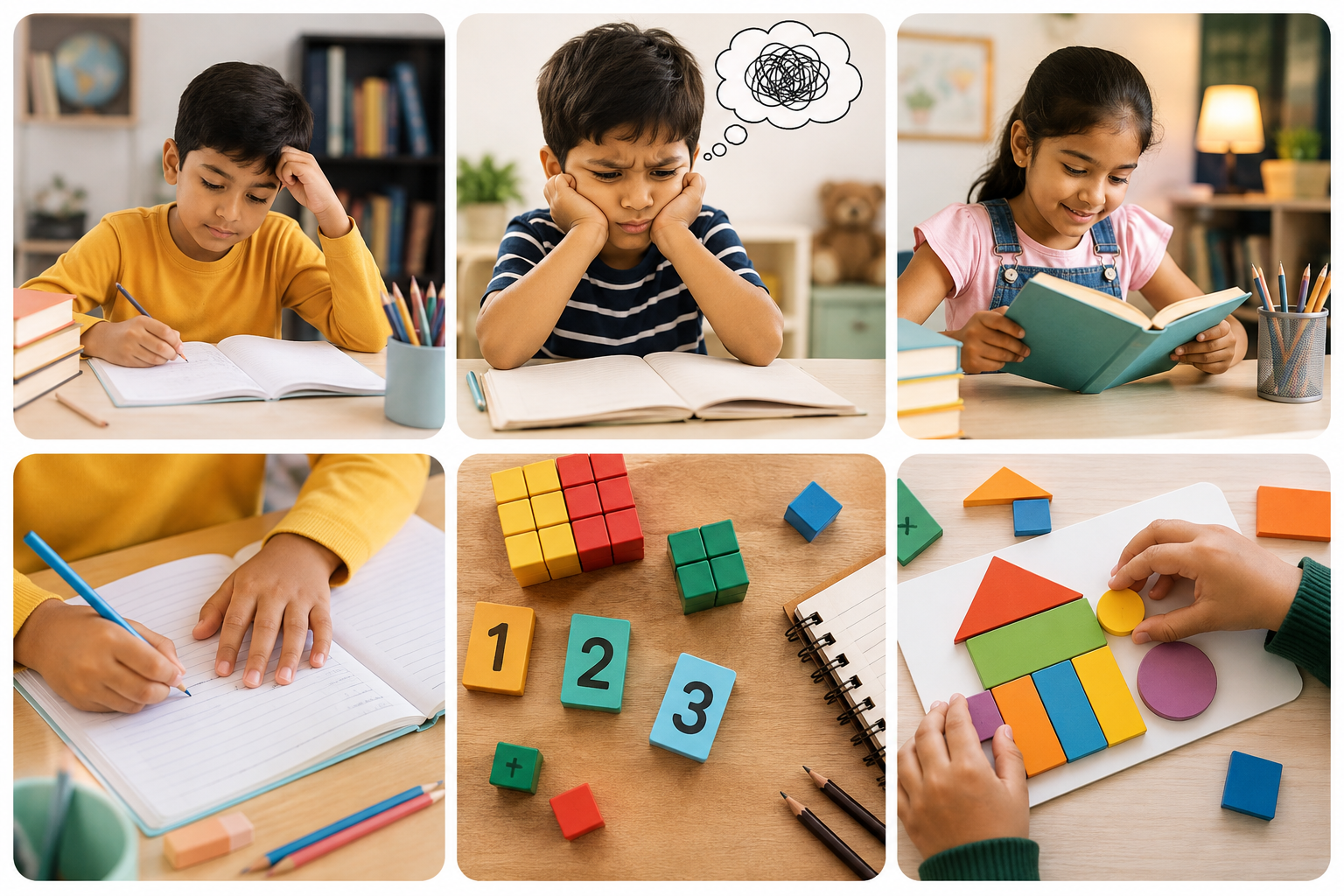
A child may understand a concept verbally but struggle to write it down. Another may read words correctly but find it difficult to understand what they have read.
IMPORTANT
Occasional difficulty is a normal part of learning.
Difficulty recognising or remembering letters and words
Avoiding reading aloud or becoming anxious about reading
Difficulty understanding what has been read
Challenges with spelling or sentence formation
Poor handwriting or difficulty organising written work
Difficulty understanding number concepts
Confusion with mathematical operations
Needing frequent reminders or assistance
Losing confidence or becoming frustrated during learning
♡
When challenges continue over time, a more individualised learning approach may help the child participate with greater understanding and confidence.
READING SUPPORT
Building Reading Skills Step by Step
Reading involves several connected abilities—from recognising letters and understanding sounds to identifying words, reading fluently and understanding meaning.
Letter Recognition
Building familiarity with letters and their forms.
Phonological Awareness
Helping children recognise and work with sounds within spoken language.
Sound–Letter Association
Understanding how letters and combinations of letters represent sounds.
Word Recognition
Developing familiarity with frequently used words.
Reading Fluency
Supporting smoother and more confident reading.
Reading Comprehension
Helping children understand, remember and discuss what they have read.
The goal is to gradually make reading feel more understandable, achievable and meaningful.
 Recognise
Read • Understand • Grow
Recognise
Read • Understand • Grow

WRITING SUPPORT
Helping Children Express Their Ideas More Confidently
Writing requires children to coordinate several skills at the same time—from organising ideas and remembering spelling to forming letters and constructing sentences.
Letter Formation
Handwriting
Spacing & Alignment
Spelling
Vocabulary
Sentence Construction
Grammar
Written Expression
Organising Ideas
Copying Tasks
✎
Visual prompts, structured worksheets, guided writing and step-by-step instructions can help reduce the demands of a writing activity.
As confidence develops, assistance can gradually be reduced to encourage greater independence.
NUMERACY SUPPORT
Making Numbers and Mathematical Concepts Easier to Understand
Mathematics becomes easier when children understand what numbers and operations represent, rather than simply memorising answers.

1 2 3
Real objects, pictures, visual examples and practical activities can help children understand mathematical ideas before moving towards abstract calculations.
✦
Breaking calculations into smaller steps can make complex activities feel less overwhelming.
ADAPT THE METHOD, NOT THE EXPECTATION TO LEARN
Making Learning More Comfortable and Manageable
When a child repeatedly finds an academic task difficult, simply increasing the amount of practice may not always solve the problem.
Sometimes the way the skill is being taught needs to change.
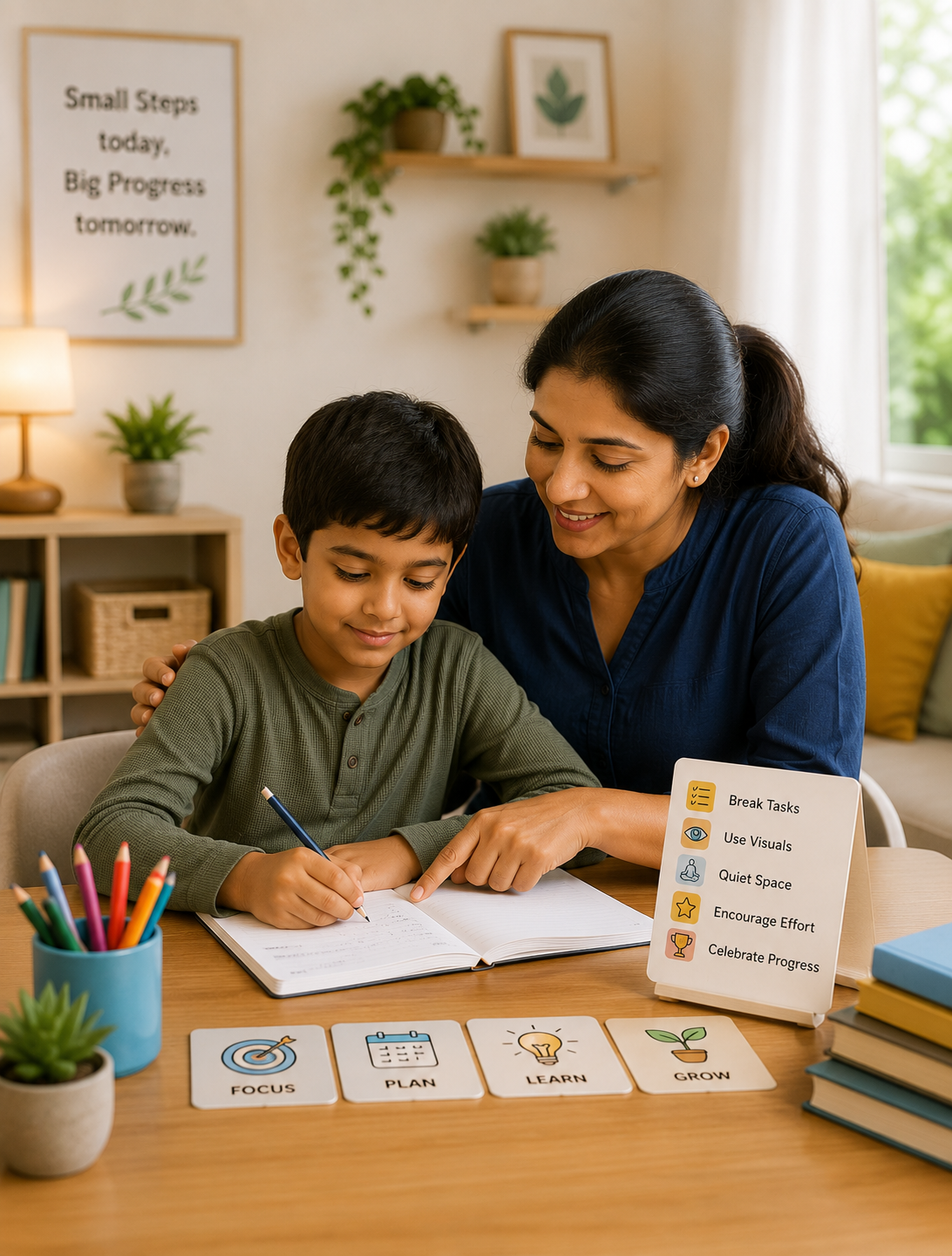
Smaller Steps
Break larger activities into achievable parts.
Visual Support
Use pictures, diagrams and clear visual examples.
Hands-On Learning
Use real objects and activities to explain concepts.
Repetition
Revisit skills in different ways to strengthen understanding.
Clear Instructions
Give one manageable direction at a time.
Processing Time
Allow enough time to understand and respond.
Positive Reinforcement
Recognise effort and progress rather than only mistakes.

THE RIGHT APPROACH
can change how learning feels.
BUILDING CONFIDENCE ALONGSIDE ACADEMIC SKILLS
Children Need to Feel “I Can Do This.”
Repeated difficulty can affect more than academic performance. It can influence how children begin to see themselves as learners.
“I can't do it.”
“This is too difficult.”
“I don't want to study.”
Academic support should therefore protect a child's confidence and willingness to learn while still helping them move towards progressively more challenging goals.
♡
Small achievements matter.
A correctly recognised word, an independently written sentence or a maths problem completed with less assistance can all represent meaningful progress.
PROGRESS
is personal.
Understand
Practise
Grow
HOW PARENTS CAN SUPPORT LEARNING AT HOME
Home Does Not Need to Become Another Classroom
Short, relaxed learning opportunities incorporated into everyday routines can often be more useful than long stressful study sessions.
Read Together
Spend 10–15 relaxed minutes reading together.
Talk About Stories
Ask simple questions and encourage your child to describe pictures.
Use Everyday Writing
Practise shopping lists, small notes or labels.
Count Real Objects
Use everyday household items to practise counting and quantities.
Explore Money
Introduce money concepts naturally while shopping.
Use Clocks & Calendars
Build familiarity with time, dates and daily schedules.
Play Learning Games
Use simple number and word games to make practice enjoyable.
Use Smaller Instructions
Break directions into manageable steps.
Praise Persistence
Recognise effort, patience and willingness to try.
Allow Breaks
Pause when learning begins to feel overwhelming.

WHAT PARENTS CAN OBSERVE
Notice the Pattern, Not Just the Result
If you are concerned about your child's academic progress, observations from everyday learning can provide useful information.
What does my child find difficult?
Reading, writing, mathematics or several areas?
When does the difficulty appear?
During homework, classroom activities or both?
What makes learning easier?
Pictures, demonstrations, repetition or hands-on activities?
How much assistance is needed?
Does the child begin independently or require frequent prompts?
Is the skill remembered later?
Can the child demonstrate the same learning the following day?
How does my child respond emotionally?
Notice frustration, avoidance, anxiety or willingness to try.
PERSONALISED ACADEMIC LEARNING SUPPORT AT ASTRAKIDS
One Child. One Individual Learning Journey.
Every child's learning profile can be different.
Rather than expecting every child to learn through exactly the same method, AstraKids focuses on identifying the child's current abilities, learning needs and strengths.
01
Understand Current Skills
→
02
Identify Learning Needs
→
03
Set Achievable Goals
→
04
Use Suitable Strategies
→
05
Review Progress
Reading
Build word recognition, fluency and comprehension.
Writing
Strengthen handwriting, spelling and written expression.
Numeracy
Strengthen number understanding and mathematical reasoning.
HELP YOUR CHILD MOVE FORWARD WITH CONFIDENCE
Academic Difficulties Do Not Have to Make Every Learning Experience Stressful
With patient guidance, appropriate learning strategies and achievable goals, children can develop stronger foundations and greater confidence in their abilities.
?
CONCERNED ABOUT YOUR CHILD'S LEARNING?
Speak with the AstraKids team to understand how personalised
academic learning support may help.
Professional Disclaimer:
AstraKids provides personalised educational and developmental support
according to individual requirements. Progress and development timelines
may vary for every child. Website information is for general awareness
and should not replace medical diagnosis, clinical treatment or
professional healthcare advice.